

- 抑制劑
- 研究領(lǐng)域
- PI3K/Akt/mTOR信號(hào)通路
- 表觀(guān)遺傳
- 甲基化
- 免疫&炎癥
- 酪氨酸蛋白激酶
- 血管生成
- 凋亡
- 自噬
- 內(nèi)質(zhì)網(wǎng)應(yīng)激&UPR響應(yīng)
- JAK/STAT信號(hào)通路
- MAPK信號(hào)通路
- 細(xì)胞骨架
- 細(xì)胞周期
- TGF-beta/Smad信號(hào)通路
- DNA損傷/DNA修復(fù)
- 化合物庫(kù)
- 抗體
- 生物試劑
- qPCR
- 2x SYBR Green qPCR Master Mix
- 2x SYBR Green qPCR Master Mix(Low ROX)
- 2x SYBR Green qPCR Master Mix(High ROX)
- 蛋白實(shí)驗(yàn)
- Protein A/G免疫沉淀磁珠
- Anti-DYKDDDDK Tag免疫磁珠
- Anti-DYKDDDDK Tag親和凝膠
- Anti-Myc免疫磁珠
- Anti-HA免疫磁珠
- 磁力架
- Poly DYKDDDDK Tag多肽
- 細(xì)胞核與細(xì)胞漿蛋白抽提試劑盒
- 免疫磁珠
- 蛋白酶抑制劑Cocktail
- 蛋白酶抑制劑Cocktail(DMSO儲(chǔ)液)
- 磷酸酶抑制劑Cocktail
- 細(xì)胞實(shí)驗(yàn)
- Cell Counting Kit-8 (CCK-8)
- 動(dòng)物實(shí)驗(yàn)
- 鼠尾直接PCR試劑盒(快速基因型鑒定)
- 小鼠CD3+ T細(xì)胞分選試劑盒
- 小鼠CD4+ T細(xì)胞分選試劑盒
- 小鼠CD8+ T細(xì)胞分選試劑盒
- 新產(chǎn)品
- 聯(lián)系我們
I-BET151 (GSK1210151A)
I-BET151 (GSK1210151A)是一種新型,選擇性的BET抑制劑,作用于BRD2,無(wú)細(xì)胞試驗(yàn)中BRD3和BRD4,IC50分別為0.5 μM, 0.25 μM和0.79 μM。
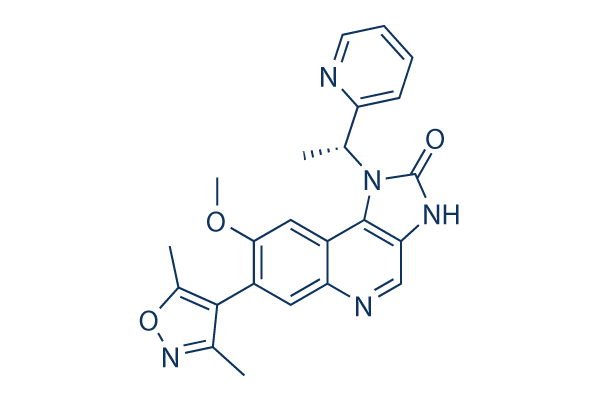
I-BET151 (GSK1210151A) Chemical Structure
CAS: 1300031-49-5


產(chǎn)品質(zhì)控
批次:
純度:
99.99%
99.99
I-BET151 (GSK1210151A)相關(guān)產(chǎn)品
| 相關(guān)靶點(diǎn) | BET p300/CBP BRPF bromodomain | 點(diǎn)擊展開(kāi) |
|---|---|---|
| 相關(guān)產(chǎn)品 | ICG-001 Birabresib (OTX015) Molibresib (I-BET-762) SGC-CBP30 EED226 Apabetalone (RVX-208) KG-501 CPI-203 compound 3i (666-15) PFI-3 AZD5153 6-hydroxy-2-naphthoic acid PFI-1 (PF-6405761) Mivebresib (ABBV-075) ABBV-744 UNC1215 I-BRD9 Bromosporine GSK1324726A (I-BET726) PLX51107 PF-CBP1 HCl Pelabresib (CPI-0610) INCB054329 MS436 UNC669 OF-1 GSK2801 MZ-1 NEO2734 CPI-637 GSK6853 I-CBP112 PFI-4 BI-7273 BI-9564 GSK 5959 INCB057643 dBET57 Histone?Acetyltransferase?Inhibitor?II | 點(diǎn)擊展開(kāi) |
| 相關(guān)化合物庫(kù) | 激酶抑制劑庫(kù) FDA藥物庫(kù) 天然產(chǎn)物庫(kù) 已知活性藥物庫(kù)-I 高選擇性抑制劑庫(kù) | 點(diǎn)擊展開(kāi) |
相關(guān)信號(hào)通路圖
細(xì)胞實(shí)驗(yàn)數(shù)據(jù)示例
| 細(xì)胞系 | 實(shí)驗(yàn)類(lèi)型 | 給藥濃度 | 孵育時(shí)間 | 活性描述 | 文獻(xiàn)信息(PMID) |
|---|---|---|---|---|---|
| HT-29 | Function assay | 0.3125 uM to 5 uM | 24 hrs | Inhibition of BRD4 in human HT-29 cells assessed as reduction in c-Myc protein expression at 0.3125 uM to 5 uM uM after 24 hrs by Western blotting method | 25559428 |
| H929 | Apoptosis assay | ~1 μM | induces cell apoptosis | 24335499 | |
| RPMI8226 | Function assay | ~1 μM | induces cell cycle arrest | 24335499 | |
| KMS11 | Function assay | ~1 μM | induces cell cycle arrest | 24335499 | |
| KMS18 | Function assay | ~1 μM | induces cell cycle arrest | 24335499 | |
| KMS12BM | Function assay | ~1 μM | induces cell cycle arrest | 24335499 | |
| KMS12PE | Function assay | ~1 μM | induces cell cycle arrest | 24335499 | |
| H929 | Function assay | ~1 μM | induces cell cycle arrest | 24335499 | |
| BC3 | Function assay | 800 nM | reduces c-Myc protein levels | 23792448 | |
| BC1 | Function assay | 800 nM | reduces c-Myc protein levels | 23792448 | |
| BC3 | Function assay | 500 nM | induces cell-cycle arrest | 23792448 | |
| BC1 | Function assay | 500 nM | induces cell-cycle arrest | 23792448 | |
| UM-PEL-3 | Growth inhibitory assay | ~1 μM | IC50=180 nM | 23792448 | |
| UM-PEL-1 | Growth inhibitory assay | ~1 μM | IC50=210 nM | 23792448 | |
| U266 | Growth inhibitory assay | ~1 μM | IC50=950 nM | 23792448 | |
| MM1S | Growth inhibitory assay | ~1 μM | IC50=760 nM | 23792448 | |
| Jurkat | Growth inhibitory assay | ~1 μM | IC50=1220 nM | 23792448 | |
| Namalwa | Growth inhibitory assay | ~1 μM | IC50=970 nM | 23792448 | |
| BJAB | Growth inhibitory assay | ~1 μM | IC50=970 nM | 23792448 | |
| BCBL1 | Growth inhibitory assay | ~1 μM | IC50=330 nM | 23792448 | |
| BC3 | Growth inhibitory assay | ~1 μM | IC50=460 nM | 23792448 | |
| BC1 | Growth inhibitory assay | ~1 μM | IC50=220 nM | 23792448 | |
| A72 | Function assay | ~10 μM | reactivates latent HIV-1 | 23255218 | |
| A2 | Function assay | ~10 μM | reactivates latent HIV-1 | 23255218 | |
| MOLM13 | Apoptosis assay | ~100 μM | induces apoptosis | 21964340 | |
| MV4;11 | Apoptosis assay | ~100 μM | induces apoptosis | 21964340 | |
| HL60 | cytotoxicity assay | ~100 μM | IC50=890 nM | 21964340 | |
| MEG01 | cytotoxicity assay | ~100 μM | IC50=25 μM | 21964340 | |
| K562 | cytotoxicity assay | ~100 μM | IC50>100 μM | 21964340 | |
| HEL | cytotoxicity assay | ~100 μM | IC50=1 μM | 21964340 | |
| NOMO1 | cytotoxicity assay | ~100 μM | IC50=15 nM | 21964340 | |
| MOLM13 | cytotoxicity assay | ~100 μM | IC50=120 nM | 21964340 | |
| RS4;11 | cytotoxicity assay | ~100 μM | IC50=192 nM | 21964340 | |
| MV4;11 | cytotoxicity assay | ~100 μM | IC50=26 nM | 21964340 | |
| KMS12PE | Apoptosis assay | ~1 μM | induces cell apoptosis | 24335499 | |
| KMS12BM | Apoptosis assay | ~1 μM | induces cell apoptosis | 24335499 | |
| KMS18 | Apoptosis assay | ~1 μM | induces cell apoptosis | 24335499 | |
| KMS11 | Apoptosis assay | ~1 μM | induces cell apoptosis | 24335499 | |
| RPMI8226 | Apoptosis assay | ~1 μM | induces cell apoptosis | 24335499 | |
| U87MG | Function assay | ~10 μM | reduces U87MG cellular ATP with IC50 of 1.05 μM | 24496381 | |
| A172 | Function assay | ~10 μM | reduces cellular ATP with IC50 of 1.28 μM | 24496381 | |
| SW1783 | Function assay | ~10 μM | reduces cellular ATP with IC50 of 2.68 μM | 24496381 | |
| U87MG | Function assay | ~10 μM | increases proportion of cells in the G1/S transition | 24496381 | |
| RAW267.4 | Function assay | 1 μM | reduces IL-6 production induced by LPS | 24859008 | |
| RAW267.4 | Function assay | 1 μM | reduces the association between BRD4 and acetylated p65 | 24859008 | |
| Me007 | Growth inhibitory assay | ~100 μM | inhibits the growth | 24906137 | |
| SK-Mel-28 | Growth inhibitory assay | ~100 μM | inhibits the growth | 24906137 | |
| Mel-RMU | Growth inhibitory assay | ~100 μM | inhibits the growth | 24906137 | |
| Mel-JD | Growth inhibitory assay | ~100 μM | inhibits the growth | 24906137 | |
| Mel-RM | Growth inhibitory assay | ~100 μM | inhibits the growth | 24906137 | |
| Me007 | Apoptosis assay | ~100 μM | induces apoptosis | 24906137 | |
| SK-Mel-28 | Apoptosis assay | ~100 μM | induces apoptosis | 24906137 | |
| Mel-RMU | Apoptosis assay | ~100 μM | induces apoptosis | 24906137 | |
| Mel-JD | Apoptosis assay | ~100 μM | induces apoptosis | 24906137 | |
| Mel-RM | Apoptosis assay | ~100 μM | induces apoptosis | 24906137 | |
| Me007 | Function assay | 10 μM | induces cell cycle arrest by upregulation of p21 | 24906137 | |
| SK-Mel-28 | Function assay | 10 μM | induces cell cycle arrest by upregulation of p21 | 24906137 | |
| Mel-RMU | Function assay | 10 μM | induces cell cycle arrest by upregulation of p21 | 24906137 | |
| Mel-JD | Function assay | 10 μM | induces cell cycle arrest by upregulation of p21 | 24906137 | |
| Mel-RM | Function assay | 10 μM | induces cell cycle arrest by upregulation of p21 | 24906137 | |
| Me007 | Function assay | 10 μM | upregulates proapoptotic and cell cycle arrest genes | 24906137 | |
| SK-Mel-28 | Function assay | 10 μM | upregulates proapoptotic and cell cycle arrest genes | 24906137 | |
| Mel-RMU | Function assay | 10 μM | upregulates proapoptotic and cell cycle arrest genes | 24906137 | |
| Mel-JD | Function assay | 10 μM | upregulates proapoptotic and cell cycle arrest genes | 24906137 | |
| Mel-RM | Function assay | 10 μM | upregulates proapoptotic and cell cycle arrest genes | 24906137 | |
| HepG2 | Function assay | 18 hrs | Upregulation of ApoA1 expression in human HepG2 cells assessed as concentration required to increase 70% of luciferase activity after 18 hrs by luciferase reporter gene assay, EC170 = 0.09 μM. | 22386529 | |
| Raji | Function assay | 4 hrs | Inhibition of BRD4 in human Raji cells assessed as reduction of MYC expression after 4 hrs, IC50 = 0.13 μM. | 24900758 | |
| MV4-11 | Growth inhibition assay | 72 hrs | Growth inhibition of human MV4-11 cells after 72 hrs by SRB assay, IC50 = 0.119 μM. | 25559428 | |
| MM1S | Growth inhibition assay | 72 hrs | Growth inhibition of human MM1S cells after 72 hrs by SRB assay, IC50 = 0.299 μM. | 25559428 | |
| HT-29 | Growth inhibition assay | 72 hrs | Growth inhibition of human HT-29 cells after 72 hrs by SRB assay, IC50 = 0.945 μM. | 25559428 | |
| Rosetta2 DE3 | Function assay | 30 mins | Displacement of FAM-labeled ZBA248 from BRD4 BD1 (44 to 168 amino acid residues) (unknown origin) expressed in Rosetta2 DE3 cells after 30 mins by fluorescence polarization assay, IC50 = 0.0317 μM. | 26080064 | |
| MV4-11 | Cytotoxicity assay | 4 days | Cytotoxicity against human MV4-11 cells harboring MLL1 fusion gene assessed as growth inhibition after 4 days by CellTiter-Glo luminescent assay, IC50 = 0.162 μM. | 26080064 | |
| Rosetta2 DE3 | Function assay | 30 mins | Displacement of FAM-labeled ZBA248 from BRD4 BD2 (333 to 460 amino acid residues) (unknown origin) expressed in Rosetta2 DE3 cells after 30 mins by fluorescence polarization assay, IC50 = 0.226 μM. | 26080064 | |
| MOLM13 | Cytotoxicity assay | 4 days | Cytotoxicity against human MOLM13 cells harboring MLL1 fusion gene assessed as growth inhibition after 4 days by CellTiter-Glo luminescent assay, IC50 = 0.228 μM. | 26080064 | |
| Rosetta2 DE3 | Function assay | 30 mins | Inhibition of FAM-labeled ZBA248 binding to recombinant human N-terminal His6-tagged BRD4 bromodomain 1 (44 to 168 residues) expressed in Rosetta2 DE3 cells after 30 mins by Flourescence polarization assay, IC50 = 0.0317 μM. | 28463487 | |
| MV4-11 | Growth inhibition assay | 4 days | Growth inhibition of human MV4-11 cells after 4 days by WST-8 assay, IC50 = 0.162 μM. | 28463487 | |
| Rosetta2 DE3 | Function assay | 30 mins | Inhibition of FAM-labeled ZBA248 binding to recombinant human N-terminal His6-tagged BRD4 bromodomain 2 (333 to 460 residues) expressed in Rosetta2 DE3 cells after 30 mins by Flourescence polarization assay, IC50 = 0.226 μM. | 28463487 | |
| MOLM13 | Growth inhibition assay | 4 days | Growth inhibition of human MOLM13 cells after 4 days by WST-8 assay, IC50 = 0.228 μM. | 28463487 | |
| Rosetta2 DE3 | Function assay | 30 mins | Displacement of FAM-labeled ZBA248 from BRD3 BD1 (24 to 144 amino acid residues) (unknown origin) expressed in Rosetta2 DE3 cells after 30 mins by fluorescence polarization assay, Ki = 0.0072 μM. | 26080064 | |
| Rosetta2 DE3 | Function assay | 30 mins | Displacement of FAM-labeled ZBA248 from BRD4 BD1 (44 to 168 amino acid residues) (unknown origin) expressed in Rosetta2 DE3 cells after 30 mins by fluorescence polarization assay, Ki = 0.009 μM. | 26080064 | |
| Rosetta2 DE3 | Function assay | 30 mins | Displacement of FAM-labeled ZBA248 from BRD2 BD1 (72 to 205 amino acid residues) (unknown origin) expressed in Rosetta2 DE3 cells after 30 mins by fluorescence polarization assay, Ki = 0.009 μM. | 26080064 | |
| Rosetta2 DE3 | Function assay | 30 mins | Displacement of FAM-labeled ZBA248 from BRD3 BD2 (306 to 417 amino acid residues) (unknown origin) expressed in Rosetta2 DE3 cells after 30 mins by fluorescence polarization assay, Ki = 0.0223 μM. | 26080064 | |
| Rosetta2 DE3 | Function assay | 30 mins | Displacement of FAM-labeled ZBA248 from BRD2 BD2 (349 to 460 amino acid residues) (unknown origin) expressed in Rosetta2 DE3 cells after 30 mins by fluorescence polarization assay, Ki = 0.0496 μM. | 26080064 | |
| Rosetta2 DE3 | Function assay | 30 mins | Displacement of FAM-labeled ZBA248 from BRD4 BD2 (333 to 460 amino acid residues) (unknown origin) expressed in Rosetta2 DE3 cells after 30 mins by fluorescence polarization assay, Ki = 0.0748 μM. | 26080064 | |
| Rosetta2 DE3 | Function assay | 30 mins | Inhibition of FAM-labeled ZBA248 binding to recombinant human N-terminal His6-tagged BRD4 bromodomain 1 (44 to 168 residues) expressed in Rosetta2 DE3 cells after 30 mins by Flourescence polarization assay, Ki = 0.009 μM. | 28463487 | |
| Rosetta2 DE3 | Function assay | 30 mins | Inhibition of FAM-labeled ZBA248 binding to recombinant human N-terminal His6-tagged BRD4 bromodomain 2 (333 to 460 residues) expressed in Rosetta2 DE3 cells after 30 mins by Flourescence polarization assay, Ki = 0.0748 μM. | 28463487 | |
| PBMC | Function assay | inhibits IL-6 with pIC50 of 6.7 | 22437115 | ||
| MV4;11 | Function assay | decreases the recruitment of BRD3/4 and impaired recruitment of CDK9 and PAF1 to the transcriptional start site | 21964340 | ||
| Rosetta2 DE3 | Function assay | Binding affinity to biotinylated BRD3 BD1 (24 to 144 amino acid residues) (unknown origin) expressed in Rosetta2 DE3 cells by bio-layer interferometry method, Kd = 0.0298 μM. | 26080064 | ||
| Rosetta2 DE3 | Function assay | Binding affinity to biotinylated BRD3 BD2 (306 to 417 amino acid residues) (unknown origin) expressed in Rosetta2 DE3 cells by bio-layer interferometry method, Kd = 0.0405 μM. | 26080064 | ||
| Rosetta2 DE3 | Function assay | Binding affinity to biotinylated BRD4 BD1 (44 to 168 amino acid residues) (unknown origin) expressed in Rosetta2 DE3 cells by bio-layer interferometry method, Kd = 0.0528 μM. | 26080064 | ||
| Rosetta2 DE3 | Function assay | Binding affinity to biotinylated BRD2 BD1 (72 to 205 amino acid residues) (unknown origin) expressed in Rosetta2 DE3 cells by bio-layer interferometry method, Kd = 0.0548 μM. | 26080064 | ||
| Rosetta2 DE3 | Function assay | Binding affinity to biotinylated BRD2 BD2 (349 to 460 amino acid residues) (unknown origin) expressed in Rosetta2 DE3 cells by bio-layer interferometry method, Kd = 0.0703 μM. | 26080064 | ||
| Rosetta2 DE3 | Function assay | Binding affinity to biotinylated BRD4 BD2 (333 to 460 amino acid residues) (unknown origin) expressed in Rosetta2 DE3 cells by bio-layer interferometry method, Kd = 0.215 μM. | 26080064 | ||
| Rosetta2 DE3 | Function assay | Binding affinity to biotinylated CREBBP (1043 to 1159 amino acid residues) (unknown origin) expressed in Rosetta2 DE3 cells by bio-layer interferometry method, Kd = 3.084 μM. | 26080064 | ||
| THP1 | Antiinflammatory assay | Antiinflammatory activity in human THP1 cells | 22386529 | ||
| MV4-11 | Function assay | Inhibition of BRD4 in human MV4-11 cells assessed as downregulation of BCL2 RNA expression by RNA-seq analysis | 29259751 | ||
| MV4-11 | Function assay | Inhibition of BRD4 in human MV4-11 cells assessed as downregulation of cMYC RNA expression by RNA-seq analysis | 29259751 | ||
| U-2 OS | qHTS assay | qHTS of pediatric cancer cell lines to identify multiple opportunities for drug repurposing: Primary screen for U-2 OS cells | 29435139 | ||
| A673 | qHTS assay | qHTS of pediatric cancer cell lines to identify multiple opportunities for drug repurposing: Primary screen for A673 cells | 29435139 | ||
| DAOY | qHTS assay | qHTS of pediatric cancer cell lines to identify multiple opportunities for drug repurposing: Primary screen for DAOY cells | 29435139 | ||
| BT-37 | qHTS assay | qHTS of pediatric cancer cell lines to identify multiple opportunities for drug repurposing: Primary screen for BT-37 cells | 29435139 | ||
| RD | qHTS assay | qHTS of pediatric cancer cell lines to identify multiple opportunities for drug repurposing: Primary screen for RD cells | 29435139 | ||
| SK-N-SH | qHTS assay | qHTS of pediatric cancer cell lines to identify multiple opportunities for drug repurposing: Primary screen for SK-N-SH cells | 29435139 | ||
| BT-12 | qHTS assay | qHTS of pediatric cancer cell lines to identify multiple opportunities for drug repurposing: Primary screen for BT-12 cells | 29435139 | ||
| MG 63 (6-TG R) | qHTS assay | qHTS of pediatric cancer cell lines to identify multiple opportunities for drug repurposing: Primary screen for MG 63 (6-TG R) cells | 29435139 | ||
| NB1643 | qHTS assay | qHTS of pediatric cancer cell lines to identify multiple opportunities for drug repurposing: Primary screen for NB1643 cells | 29435139 | ||
| OHS-50 | qHTS assay | qHTS of pediatric cancer cell lines to identify multiple opportunities for drug repurposing: Primary screen for OHS-50 cells | 29435139 | ||
| fibroblast cells | qHTS assay | qHTS of pediatric cancer cell lines to identify multiple opportunities for drug repurposing: Primary screen for control Hh wild type fibroblast cells | 29435139 | ||
| Rh41 | qHTS assay | qHTS of pediatric cancer cell lines to identify multiple opportunities for drug repurposing: Primary screen for Rh41 cells | 29435139 | ||
| Rh30 | qHTS assay | qHTS of pediatric cancer cell lines to identify multiple opportunities for drug repurposing: Primary screen for Rh30 cells | 29435139 | ||
| SJ-GBM2 | qHTS assay | qHTS of pediatric cancer cell lines to identify multiple opportunities for drug repurposing: Primary screen for SJ-GBM2 cells | 29435139 | ||
| SK-N-MC | qHTS assay | qHTS of pediatric cancer cell lines to identify multiple opportunities for drug repurposing: Primary screen for SK-N-MC cells | 29435139 | ||
| NB-EBc1 | qHTS assay | qHTS of pediatric cancer cell lines to identify multiple opportunities for drug repurposing: Primary screen for NB-EBc1 cells | 29435139 | ||
| LAN-5 | qHTS assay | qHTS of pediatric cancer cell lines to identify multiple opportunities for drug repurposing: Primary screen for LAN-5 cells | 29435139 | ||
| Rh18 | qHTS assay | qHTS of pediatric cancer cell lines to identify multiple opportunities for drug repurposing: Primary screen for Rh18 cells | 29435139 | ||
| 點(diǎn)擊查看更多細(xì)胞系數(shù)據(jù) | |||||
生物活性
| 產(chǎn)品描述 | I-BET151 (GSK1210151A)是一種新型,選擇性的BET抑制劑,作用于BRD2,無(wú)細(xì)胞試驗(yàn)中BRD3和BRD4,IC50分別為0.5 μM, 0.25 μM和0.79 μM。 | ||||||
|---|---|---|---|---|---|---|---|
| 特性 | 優(yōu)化I-BET151,使其有效及選擇性靶向作用于BET,同時(shí)增強(qiáng)體內(nèi)藥代動(dòng)力學(xué)和終末半衰期,以使延長(zhǎng)體內(nèi)研究。 | ||||||
| 靶點(diǎn) |
|
| 體外研究(In Vitro) | ||||
| 體外研究活性 | I-BET151有效,選擇性作用于多種不同蛋白類(lèi)型,如COX-2, P450, Aurora B, GSK3β, PI3K-γ, GPCR, 離子通道,轉(zhuǎn)運(yùn)體。與I-BET762 (GSK525762A)類(lèi)似, I-BET151 對(duì)BRD2, BRD3 和BRD4具有高的結(jié)合親和力,Kd為0.02-0.1 μM,作用于人類(lèi)外周血單核細(xì)胞(PBMC)和全血(WB)以及大鼠WB,顯著抑制脂多糖刺激的IL-6細(xì)胞因子產(chǎn)生,IC50分別為0.16 μM, 1.26 μM, 和 1.26 μM。I-BET151(0.5 or 5 μM)作用于HL60核提取物,抑制BETs(BRD2, BRD3, BRD4, 和 BRD9)而非23種其他溴區(qū)蛋白結(jié)合到乙酰化的組蛋白肽。I-BET151有效作用于含不同 MLL融合的細(xì)胞系,如MV4;11, RS4;11, MOLM13, 和NOMO1 細(xì)胞, IC50為15-192 nM。一致的是,I-BET151完全消除MLL融合驅(qū)動(dòng)的白血病(MOLM13)而非酪氨酸激酶激活(K562)驅(qū)動(dòng)的白血病的菌落形成潛力。I-BET151也有效作用于液體培養(yǎng)和轉(zhuǎn)化MLL-ENL或MLL-AF9的原代小鼠祖細(xì)胞的克隆形成實(shí)驗(yàn)。I-BET151作用于由不同的MLL融合(分別含MLL-AF9和MLL-AF4的MOLM13和MV4;11)而非K562細(xì)胞驅(qū)動(dòng)的MLL融合細(xì)胞系,顯著誘導(dǎo)細(xì)胞凋亡和G0/G1期停滯,可能是由于通過(guò)抑制BRD3/4,PAFc和SEC組分招募到轉(zhuǎn)錄起始位點(diǎn)(TSS),而抑制BCL-2,C-MYC和CDK6的轉(zhuǎn)錄。[1] | |||
|---|---|---|---|---|
| 激酶實(shí)驗(yàn) | 熒光各向異性(FP)的配體位移檢測(cè) | |||
| 所有組分溶解在50 mM HEPES pH 7.4, 150 mM NaCl和 0.5 mM CHAPS組成的Buffer中,BRD 2/3/4終濃度為75 nM,熒光配體為5 nM。在Greiner 384孔黑色的低量微孔板中,使用Micro Multidrop 將10 μL反應(yīng)混合物加入到含100 nL各種濃度I-BET151或DMSO空白對(duì)照(1%最終)的孔中,并在黑暗中室溫下平衡60分鐘。使用 Envision (lex=485 nm,lEM=530 nm;Dichroic=505 nM)讀取熒光各向異性。 | ||||
| 細(xì)胞實(shí)驗(yàn) | 細(xì)胞系 | MV4;11, MOLM13, NOMO1, RS4;11, HEL, HL60 和 K562 | ||
| 濃度 | 溶于DMSO, 終濃度為~100 μM | |||
| 孵育時(shí)間 | 24,或72小時(shí) | |||
| 方法 | 使用多種不同濃度I-BET151在384孔或96孔板中處理細(xì)胞24或72小時(shí)。細(xì)胞生長(zhǎng)抑制實(shí)驗(yàn)中,實(shí)驗(yàn)板每孔中加入與細(xì)胞培養(yǎng)基同等體積的CellTiter-Glo試劑,震蕩約2分鐘,然后在Analyst GT 或EnVision酶標(biāo)儀上讀取化學(xué)發(fā)光信號(hào)。細(xì)胞增殖實(shí)驗(yàn)中,每孔加入CellTiter-Aqueous One,然后實(shí)驗(yàn)板在37°C下溫育4小時(shí)。在SpectraMax Gemini酶標(biāo)儀上490 nm處讀取吸光度。 |
|||
| 實(shí)驗(yàn)圖片 | 檢測(cè)方法 | 檢測(cè)指標(biāo) | 實(shí)驗(yàn)圖片 | PMID |
| Western blot | HP1α / HP1β / HP1γ FoxM1 / AURKB / Survivin / cyclin B / PLK1 α-SMA / Fibronectin / Collagen-1 |
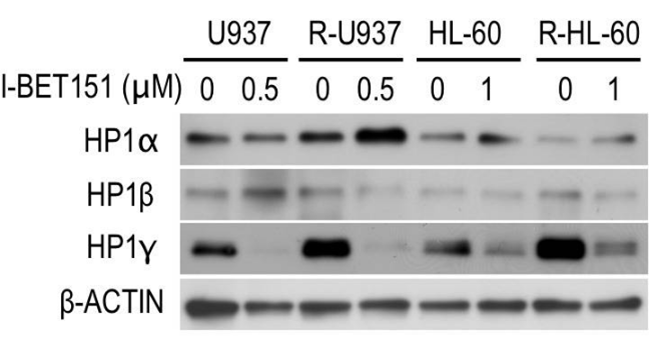
|
30386240 | |
| 體內(nèi)研究(In Vivo) | ||
| 體內(nèi)研究活性 | I-BET151每天按30 mg/kg劑量處理小鼠,顯著抑制鼠類(lèi)MLL-AF9和人類(lèi)MLL-AF4白血病腫瘤生長(zhǎng),顯著延長(zhǎng)壽命。[1] | |
|---|---|---|
| 動(dòng)物實(shí)驗(yàn) | Animal Models | 靜脈注射MV4;11細(xì)胞的NOD-SCID小鼠,靜脈注射MLL-AF9細(xì)胞的C57BL/6小鼠 |
| Dosages | ~30 mg/kg/day | |
| Administration | 腹腔注射 | |
|
化學(xué)信息&溶解度
| 分子量 | 415.44 | 分子式 | C23H21N5O3 |
| CAS號(hào) | 1300031-49-5 | SDF | Download I-BET151 (GSK1210151A) SDF |
| Smiles | CC1=C(C(=NO1)C)C2=C(C=C3C(=C2)N=CC4=C3N(C(=O)N4)C(C)C5=CC=CC=N5)OC | ||
| 儲(chǔ)存條件(自收到貨起) | |||
|
體外溶解度 |
DMSO : 83 mg/mL ( (199.78 mM) ;DMSO吸濕會(huì)降低化合物溶解度,請(qǐng)使用新開(kāi)封DMSO) Ethanol : 83 mg/mL (199.78 mM) Water : Insoluble |
摩爾濃度計(jì)算器 |
|
體內(nèi)溶解配方 現(xiàn)配現(xiàn)用,請(qǐng)按從左到右的順序依次添加,澄清后再加入下一溶劑 |
動(dòng)物體內(nèi)配方計(jì)算器 | |||||
實(shí)驗(yàn)計(jì)算
摩爾濃度計(jì)算器
動(dòng)物體內(nèi)配方計(jì)算器(澄清溶液)
第一步:請(qǐng)輸入基本實(shí)驗(yàn)信息(考慮到實(shí)驗(yàn)過(guò)程中的損耗,建議多配一只動(dòng)物的藥量)
mg/kg
g
μL
只
第二步:請(qǐng)輸入動(dòng)物體內(nèi)配方組成(配方適用于不溶于水的藥物;不同批次藥物配方比例不同,請(qǐng)聯(lián)系Selleck為您提供正確的澄清溶液配方)
% DMSO
%
% Tween 80
% ddH2O
%DMSO
%
計(jì)算結(jié)果:
工作液濃度: mg/ml;
DMSO母液配制方法: mg 藥物溶于μL DMSO溶液(母液濃度mg/mL,注:如該濃度超過(guò)該批次藥物DMSO溶解度,請(qǐng)先聯(lián)系Selleck);
體內(nèi)配方配制方法:取μL DMSO母液,加入μL PEG300,混勻澄清后加入μL Tween 80,混勻澄清后加入μL ddH2O,混勻澄清。
體內(nèi)配方配制方法:取μL DMSO母液,加入μL Corn oil,混勻澄清。
注意:1. 首先保證母液是澄清的;
2.一定要按照順序依次將溶劑加入,進(jìn)行下一步操作之前必須保證上一步操作得到的是澄清的溶液,可采用渦旋、超聲或水浴加熱等物理方法助溶。
技術(shù)支持
在訂購(gòu)、運(yùn)輸、儲(chǔ)存和使用我們的產(chǎn)品的任何階段,您遇到的任何問(wèn)題,均可以通過(guò)撥打我們的熱線(xiàn)電話(huà)400-668-6834,或者技術(shù)支持郵箱[email protected],直接聯(lián)系到我們。我們會(huì)在24小時(shí)內(nèi)盡快聯(lián)系您。
如果有其他問(wèn)題,請(qǐng)給我們留言。
* 必填項(xiàng)


Copyright 2013 Selleck中國(guó). All Rights Reserved.
滬ICP備13045345號(hào)-1滬公網(wǎng)安備 31011502012800號(hào)
